
Additions and renovations
Add heating and cooling without extending undersized or hard-to-reach ductwork.
Ductless Comfort
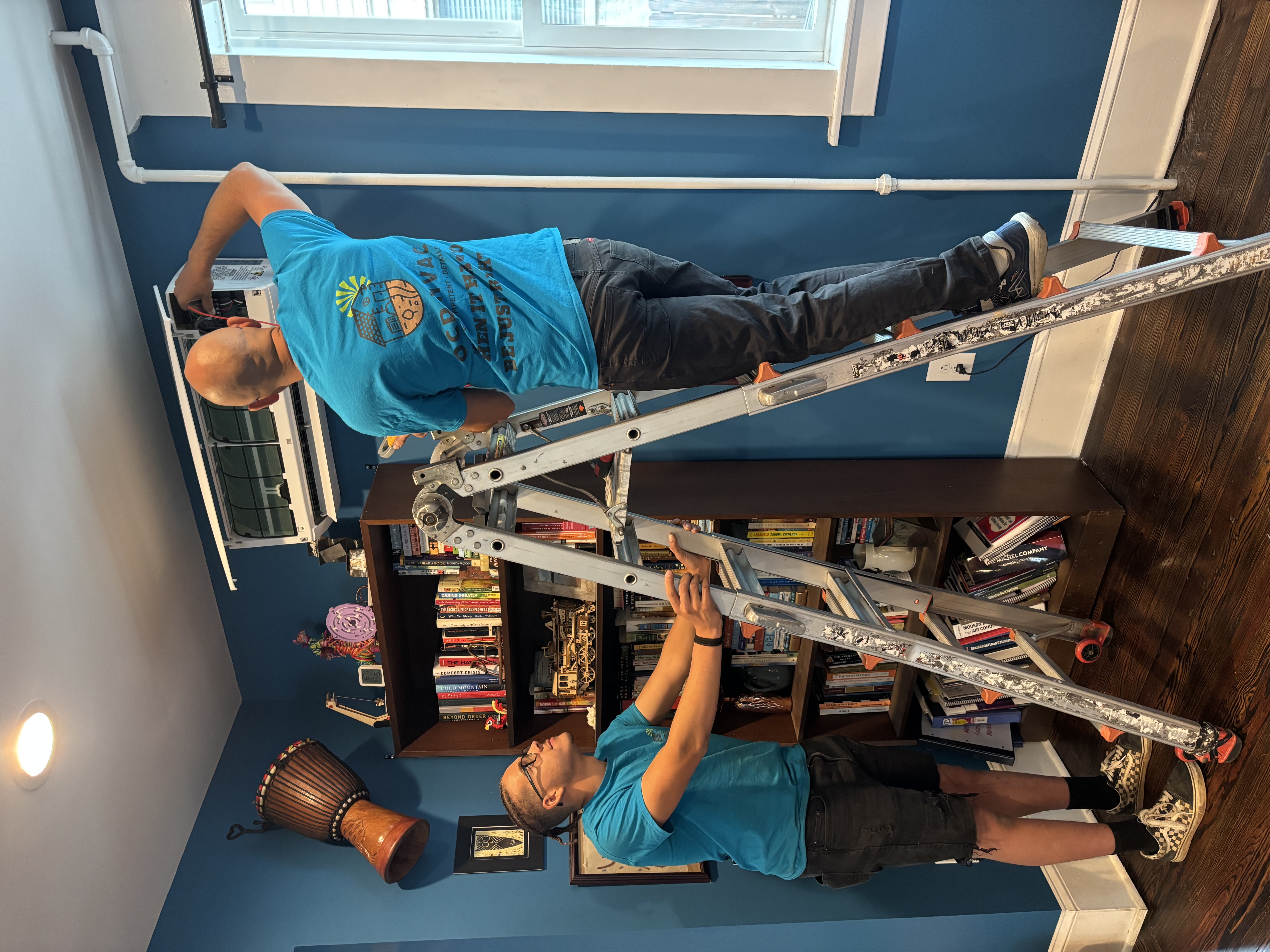
Ductless mini splits can be a great solution for additions, bonus rooms, garages, workshops, older homes, finished attics, sunrooms, and spaces where traditional ductwork is difficult, expensive, or simply does not make sense. OCD HVAC installs ductless systems with careful attention to sizing, placement, refrigerant piping, condensate management, electrical requirements, airflow, and startup verification.
On-Time ✶ Competent ✶ Detailed
Mini split installation Roanoke VA
A ductless mini split can perform extremely well when it is designed and installed correctly. The details matter: equipment sizing, indoor unit location, outdoor unit placement, line set routing, condensate drainage, electrical work, wall penetration sealing, airflow pattern, refrigerant charge, and commissioning.
OCD HVAC approaches ductless installation the same way we approach every system: understand the space, choose practical equipment, install it cleanly, and verify that it is operating the way it should.
Where ductless helps
Additions and renovations
Add heating and cooling without extending undersized or hard-to-reach ductwork.
Bonus rooms and finished attics
Improve comfort in rooms that run too hot, too cold, or too far from the main HVAC system.
Older homes
Add efficient heating and cooling where ductwork would be invasive, expensive, or impractical.
Garages and workshops
Condition work areas without tying them into the main house duct system.
Sunrooms and enclosed porches
Help make hard-to-condition spaces more useful through more of the year.
Problem rooms
Solve comfort issues in rooms that never seem to match the rest of the house.
Practical recommendations
Mini splits are excellent tools, but they are not magic. Sometimes a ductless system is the right answer. Sometimes the better answer is duct repair, airflow correction, insulation improvements, a better load calculation, or changes to the existing HVAC system. OCD HVAC looks at the room, the house, and the existing equipment before recommending a direction.
The point is not to push ductless HVAC where it does not belong. The point is to solve the comfort problem with the right level of work.
Installed, commissioned, verified
01
We look at the room, insulation, windows, sun exposure, comfort complaints, usage, and how the space connects to the rest of the home.
02
We explain whether ductless makes sense, where indoor and outdoor equipment could go, and what tradeoffs are involved.
03
We avoid guessing. Oversized equipment can short-cycle, underperform, or fail to control humidity properly.
04
We consider line set routing, condensate drainage, wall penetrations, electrical requirements, outdoor unit placement, service access, and appearance.
05
We focus on neat workmanship, proper sealing, solid mounting, safe electrical connections, and practical serviceability.
06
We check operation, temperature split, drainage, controls, refrigerant-related details where applicable, and basic system performance before calling the job complete.
System options
Some homes only need one ductless unit for a specific room or addition. Others may benefit from a multi-zone system serving several areas. The right choice depends on the layout, load, comfort goals, equipment location options, and budget.
Best for one room, addition, garage, workshop, or problem area.
Simpler design.
Often the most straightforward ductless solution.
Can serve multiple rooms from one outdoor unit.
More design-sensitive.
Requires careful planning so each zone performs well.
Details that matter
Ductless heat pump installation is still HVAC work. Placement, drainage, electrical details, access, and startup checks all affect how the system performs after the installer leaves.
Good fit or maybe not
You have an addition or bonus room that is uncomfortable.
Your older home does not have practical ductwork options.
You want heating and cooling for a garage, workshop, or finished attic.
One room is consistently hotter or colder than the rest of the house.
Extending the existing duct system would be expensive or ineffective.
You want zoned comfort in a specific area.
The real problem is poor ductwork or low airflow.
The room has major insulation or air leakage problems.
The existing HVAC system can be corrected more practically.
There is no good place for the indoor or outdoor unit.
The space needs a broader home performance solution.
Service area
OCD HVAC serves Roanoke, Salem, Vinton, Cave Spring, South Roanoke, Grandin, Wasena, Raleigh Court, Botetourt County, Daleville, Troutville, Bonsack, Hollins, and nearby areas.
FAQ
Yes, they can be a very good option for older homes, especially where adding ductwork would be invasive, expensive, or impractical. The key is choosing the right location, size, and installation approach.
Yes. Most modern ductless mini splits are heat pumps, meaning they can provide both cooling and heating. The right equipment depends on the space, comfort goals, and expected heating load.
Often, yes. A single-zone mini split can be a practical way to condition a problem room, addition, finished attic, garage, or bonus room. But it is still worth understanding why the room is uncomfortable before choosing equipment.
Yes. Filters, coils, blower wheels, drains, and outdoor units need periodic attention. Like any HVAC system, ductless equipment performs better and lasts longer when it is kept clean and checked regularly.
Sometimes. Extending ductwork can work well in some homes, but in other cases it creates airflow problems or adds load to a system that is already struggling. OCD HVAC can help compare the practical options.
Indoor unit placement depends on room layout, airflow pattern, furniture, exterior wall access, appearance, serviceability, and condensate drainage. Placement matters more than many people realize.
Yes, ductless mini splits are often used in garages and workshops. The best setup depends on insulation, air leakage, usage, electrical availability, and how comfortable you want the space to be.
Ductless Comfort, Done Carefully
If you are considering a ductless mini split for an addition, older home, garage, workshop, bonus room, finished attic, or uncomfortable space, OCD HVAC can help you figure out whether it is the right approach and what a clean installation would involve.